
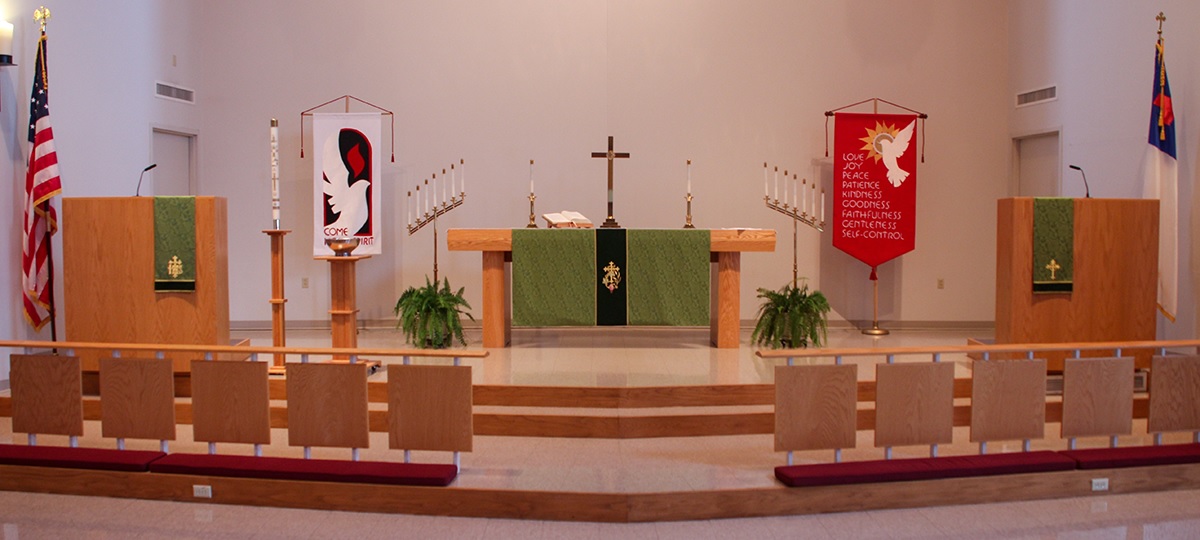
SERMON TEXT: 11.02.2025 “ALL IN OR ALL OUT?”
November 2, 2025 – All Saints Text: Matthew 5:9-12
Dear friends in Christ,
Pope Gregory IV, who died 844, shifted the feast of All Martyrs’ Day from May 13 to
November 1 and renamed it All Saints’ Day. Luther and the reformers retained this feast and elevated it to a major festival. In this way the Lutheran Church has had the closest of connections with Reformation and All Saints’ Day. The red of Reformation shifts to “Made white in the blood of the Lamb” for All Saints.
When Luther nailed the 95 theses on the Castle Church in Wittenberg on the eve of All Saints it meant something. The Castle Church held thousands of revenue-generating relics. These relics were being held to give people a right standing with God and the blessings that come with it. We hear about those blessings in our Gospel for today. We will focus in on the last section. How do these blessings work and how do we receive them? Is it . . .
“ALL IN OR ALL OUT?”
There is the piecemeal approach that works like this. Some special people, Matthew, Peter, Paul and Mary had done a lot a good in life. Disciples, leader of the early church, mother of Jesus. They had earned heaven, and they are called saints. Well, the merits of these fine people are available to us plain people. If we view these relics, we can get some of their merit. Piecemeal. A little here, credit there. This is the worldly approach of earning heaven. God gives a little grace but only gives you more if you can handle it. If you squander the grace, heaven’s faucet is shut off. This is how the world’s religions work. Piecemeal.
God’s Law reveals that we are either all in or all out. There are no degrees of goodness. If we are exemplary in behavior, God doesn’t do a checklist and say we earned more grace. Our wonderful personality and acts of charity don’t have God calling the angels in for a slide show of our wonderment. We are a part of sinful humanity, and our self-centered motivations are a glaring weakness. The Law condemns all of us. By the time we reach verse 9, the Lord has talked about many blessings. Blessings that He bestows just like this, “Blessed are the peacemakers, for they shall be called sons of God.” This is not an envoy that works to bring countries together, it is peace between God and men. The peacemaker is clearly Christ. It could be Pastors who work in Christ’s name. It can be all Christians who share in this peacemaking through their confession of Christ. “Sons of God” is Christological and has baptismal implications, for there we first receive the peace of Christ and are called sons and daughters of the Father. So, then, is it all out or all in for all of us? “Blessed are those who are persecuted for righteousness’ sake, for theirs is the kingdom of heaven.” (v. 10). Identifying with Christ has consequences. Will we ever have to stand before others and state we are all in for Christ? Will the Lord permit a persecution? Our lives should follow the pattern of Christ. Our lives should be dominated by a theology of the cross. If this should happen, the kingdom of heaven is ours. In verses 11-12 we shift to second person plural, the “you” in this beatitude is “y’all,” a change back to the present tense. We are identified with the prophets, those persecuted for Jesus and the cross. This is a source of joy and hope for the new, Christlike nature within us – even now.
The greatest of heaven’s blessings: the Gospel of free, gracious forgiveness and reconciliation proclaimed, announced, declared through the Word of God and his cross and his Baptism and his Supper. Through the Word and Sacraments, we are now declared blessed – saints – in Christ. All in! “Our Confession (in the Apology to the Augsburg Confession). Approves honoring the saints in three ways. The first is Thanksgiving. We should thank God because He has shown examples of mercy, because He wishes to save people and because He has given gifts to the Church. The saints faithfully used these gifts and should be praised. The second service is the strengthening of our faith. When we see Peter’s denial forgiven, we are also encouraged to believe all the more that grace truly abounds over sin. The third honor is the imitation, first of faith, then of the other virtues. Everyone should imitate the saints according to his calling.” The saints before us knew this. No bartering, no piecemeal. Christ and his perfect life and sacrificial death in our place. The Lord’s precious, bought-with-his-blood saints.
Amen.
SERMON TEXT 10.26.2025 — “THE WRONG ENEMY”
October 26, 2025 – Reformation Text: Exodus 20:16
Dear Friends in Christ,
One of the challenges in this profession of Pastor, when you have been at it as long as I have, is to take a Church celebration like Reformation, which comes around every year, and find different ways to preach it. Over the years I have given sermons on Luther’s bathroom habits and his love of bowling, while still remembering the message is Jesus. Today, we will do something just a little different. We will focus in on an area of Luther’s teaching. We will use a commandment. A commandment that is so abused in our society, you start to wonder if anybody is capable of being to kind to another in their words. It is the 8th commandment and here it is with Luther’s explanation:
“You shall not give false testimony against your neighbor.” What does this mean? “We should fear and love God so that we do not tell lies about our neighbor, betray him, slander him, or hurt his reputation, but defend him, speak well of him, and explain everything in the kindest way.” Simple enough. Buckle up as we explore . . .
“THE WRONG ENEMY”
It would be interesting, and I think shameful for many, if at the end of the day, somebody played a recording of our speech in a 24-hour period. Where would it fall? Would it be uplifting or demeaning? Would it help or hurt a situation? Many who struggle with this don’t even realize their talk is so hurtful. It becomes a part of who they are.
In the commandment what is the key word? It’s neighbor. Wouldn’t our talk be more Christ like if we saw others as neighbors and not enemies?
Where do we break down? In a marriage it can sound like this: “You never help with the children or in the kitchen. You just think of yourself. Why can’t you be more like that spouse or that parent.” In a church it can sound like this: “Why doesn’t he or she help out around here more. Why did they make that decision about their family. Why does the Pastor do things that way.” It is in our job, our family life, our friend life. Everywhere you look. On top of this we have the ridiculousness of the internet speech. Get off your phone, out of that chat room and just stop it.
We betray, we slander, we hurt reputations. We usually do this to save ours. Sometimes we do it just because we are bored. Who doesn’t love a little gossip? Defending a person, well that’s no fun. Luther wrote this in reflecting on the commandment:
“It is a common, pernicious plague that everyone would rather hear evil rather than good about their neighbor. Even though we ourselves are evil, we cannot tolerate it when anyone speaks evil of us; instead, we want to hear the whole world say golden things of us. Yet, we cannot bear when someone says the best things about others.”
We get hurt, so we think to hurt them back we can use our spiteful words. This is how Satan wants us to see each other. Satan drives the wedge and laughs at the fallout.
Now if we that person as neighbor and not enemy, well things are starting to turn around. A man once asked the famous question: “Who is my neighbor?” Christ answered, “Everyone.” Everyone is your neighbor, and neighbors as Christ shows in the story of the Good Samaritan are to receive mercy and compassion. Luther again: “We should use our tongue to speak only the best about all people, to cover the sins and infirmities of our neighbors, to justify their actions, and to cloak and veil them with our own honor.”
How does Christ speak of you? How does He handle your sin? Is He careless? Of course not. He is gracious and merciful, slow to anger and abounding in steadfast love. What if as you arrive each Sunday, Jesus has posted on our bulletin board the words you used during the week to slander someone? Prayerfully we would be shamed by what we have done to others. None of us is innocent of breaking this commandment.
Jesus doesn’t see you as enemy, though you have hurt him. You are friend. You are neighbor. You are His child. You are His creation. He died for you. Satan is slandering you. Christ is defending you, speaking well of you, explaining things in the kindest way. Can’t you hear him: “I know they gossiped again. I know they hurt others. I know they found a friend and let people have it. But Father, they know not what they do. They are weak. Forgive them for my sake. They are your children, and I died and rose for them. In Holy Baptism they are your own and You have saved them from sin and death.”
The next time you want to get the tongue wagging at a frustrating person, think of this. God created that person. Christ died and rose for that person. God does not create, nor does Christ die and rise, for worthless people. When you see others this way, when you pray for them, it becomes harder to use your words to hurt.
Through the Spirit, let’s make the world a better place by finding constructive things to speak. Like Luther writes, “defend him, speak well of him, and explain everything in the kindest way.” This is after all how Jesus, the friend of sinners, speaks of you.
Amen.
SERMON TEXT: 10.19.2025 — “THE GOD-BREATHED SCRIPTURES BREATHE LIFE INTO SINNERS”
October 19, 2025 Text: 2 Timothy 3:14-4:5
Dear Friends in Christ,
When was the last time you had the breath knocked out of you or had your breath taken away? Other than the first time I saw Toni, it would be when I was younger, usually playing sports. The worst was my freshman year of football. We were scrimmaging the sophomores. As a running back I came out of the backfield for a drag pass across the middle. I was concentrating on the pass when the middle linebacker knocked me into next week. I lost my breath, for a moment I had no idea where I was. In today’s world there would probably be a concussion evaluation before returning to practice. Back then it was probably a few plays off and back in there. It is a little scary, in those few seconds, when you cannot breathe.
Sin can do the same thing to us. We can have the wind knocked right out of us when we suffer the consequences of poor choices or when we get blindsided by a problem. Like me on the turf at Argenta-Oreana High school staring into space, you might lay in bed staring at the ceiling and wondering how you ever got into this situation. Sometimes we gasp for air. We need help. The Lord provides it.
“THE GOD-BREATHED SCRIPTURES BREATHE LIFE INTO SINNERS”
Throughout the Scriptures we see time and time again where sin has knocked the breath out of God’s people. Adam and Eve had God breathe life into them. Because of this creation air they were able to love and serve God perfectly. But then they threw it all away when they disobeyed their Creator. They were left gasping for air as they ran away from God. They were unable to love God or each other. In Ezekiel 37 the people of Israel are like a valley of dry bones. They are cut off and breathless because of their sinful ways and they have to live with their bad decisions. In the book of John, the disciples abandoned Jesus after he goes to the cross. They fled in fear to the upper room. They are paralyzed and breathless as they convene together on the night of Easter.
God can breathe new life into sinners. In these biblical examples God came with His divine CPR. He breathed new life back into Adam and Eve when He promised a Savior who would crush the serpent’s head. The people of Israel had new life breathed into them when He made them a promise through Ezekiel’s vision. The disciples had life pumped back into their lungs when the Savior came with His peace and breathed on them the Holy Spirit.
When Paul tells us in today’s text that the Bible is all God-breathed, he is reminding us that this same divine CPR is ours as well. When He breathes his last on the cross, it looks like how we sometimes feel. Where is the hope? But with resurrection breath, “He has risen, He is not here.” We are dead and without breath in our trespasses, but God made us alive with Christ through the Gospel. When we read the Bible, when we hear God’s Word, when the Holy Spirit works meditation into our bodies through the Book of life, we are resurrected and resuscitated. We are given new life.
The God-breathed Scriptures equip us to serve God and one another in love. The breath of God works. Adam and Eve stopped hiding from God. The people of Israel began to serve God and even their Babylonian captors in love. The disciples were given their assignment to be witnesses for Jesus. They were empowered to forgive sins.
We can do the same. The breath of God has restored each of us. We can stop hiding in our shame. We can love others, even our enemies. We can witness to the love of Christ. Through the Office of the Keys, we can forgive others because Christ first forgave us.
The Scriptures teach us. The Scriptures reprove and call us to repentance. The Scriptures correct us. The Scriptures train us in righteousness.
These words of Paul encouraged Timothy. Continuing in the Lord’s Scriptures, Timothy would have a ministry that made a difference. We have the same spiritual lift today. There are those out there spouting their different teachings. There are those out there giving the itching hears the scratch they think they need in life. We need to be aware of all of this. Our best defense is knowing the God-breathed Word of God. It is truthful and reliable. It is the breath of God for us. It can breathe new life into us . . . breathe with me . . . now we can be the people the Lord wants us to be.
Amen.